

A child can know exactly what happens every morning and still get stuck between one step and the next.
That does not necessarily mean they do not understand the routine.
Sometimes the more useful question is: what has to happen between knowing what to do and actually doing it at the right moment?
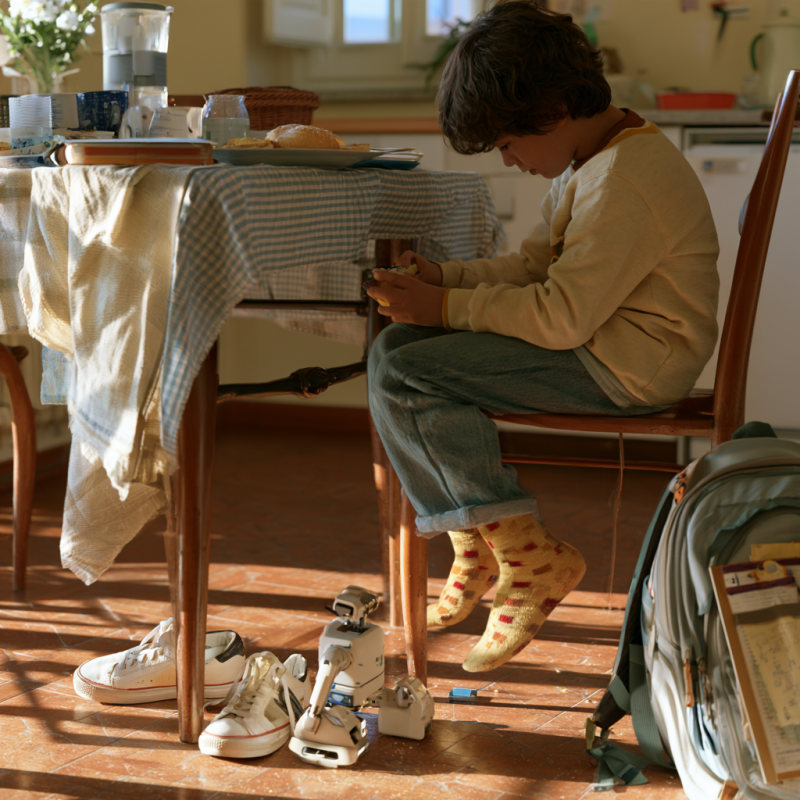
What’s happening in your child’s head while the shoes are still on the floor?
They know they need to put them on.
You have told them. Probably more than once.
The shoes are right there, ready. And this is not new: putting on shoes is part of the same routine almost every morning.
And yet the minutes pass, and the shoes are still on the floor.
It is easy to look at this scene and focus on what the child is not doing.
But for a moment, consider what has to happen before those shoes actually reach their feet.
“Put your shoes on” sounds like a simple action because, for an adult, much of the work involved has become almost invisible.
A child may need to:
- keep the goal available in their mind;
- recognize that it is time to move to that step;
- stop whatever they are currently doing;
- shift their attention;
- begin the action;
- stay with it long enough to finish.
If something else captures their attention along the way, they also need to notice that they have moved away from the task and find their way back.
And once the shoes are finally on, the morning is not over.
There is another step to retrieve and begin.
This does not mean that every child who leaves their shoes on the floor has an executive function difficulty.
And it does not mean that the same behavior always has the same explanation.
It simply means this:
Knowing what needs to happen and being able to do it at the right moment are not exactly the same operation.
That space between knowing and doing is worth looking at more closely.
“Put your shoes on” is one sentence. For the brain, it may not be one step.
Imagine slowing the morning down at exactly that moment.
The shoes are on the floor.
The child knows what shoes are for. They know how to put them on. They know they will need them before leaving the house.
So we are not necessarily looking for information they do not have.
We are looking at what needs to happen for information they already have to become action.
The next step has to remain available while other things are happening.
If the child was finishing breakfast, looking for something in a backpack, talking to someone, or thinking about something completely unrelated, “put on your shoes” has to survive long enough to guide what happens next.
Then something different has to happen:
they have to start.
Knowing that the shoes need to go on does not automatically set the action in motion.
And before starting, the child may first need to leave something else: a toy, a conversation, a thought, or an object they noticed while crossing the room.
What looks from the outside like one simple routine is often made up of many small shifts in attention and action.
That is why two children can leave the same pair of shoes on the floor for completely different reasons.
One may have lost track of the next step.
Another may know exactly what comes next but have difficulty getting started.
Another may have begun, become distracted, and failed to return to where they left off.
From the outside, the result looks the same:
the shoes are still there.
Inside, very different things may have happened.
When the parent becomes the “next step”
Something else often happens during busy mornings.
When the child stops moving through the routine, the parent naturally begins filling in the gaps.
“Now brush your teeth.”
“Get your backpack.”
“Shoes.”
“Did you get your water bottle?”
“Okay, now your jacket.”
Little by little, without anyone deliberately choosing it, the sequence moves out of the routine and into the adult’s voice.
The parent remembers what comes next.
The parent signals when it is time to begin.
The parent notices when the child has stopped.
The parent brings them back to the right place.
This can create an interesting pattern.
A child may know their morning routine very well and still wait each day for someone else to move it forward.
Not necessarily because they do not want to be independent.
The system may simply have become very efficient at working like this:
I stop → the next instruction arrives → I start again.
If we want to change that system, giving instructions faster and more often may not be the most useful place to intervene.
Instead, we can change where the child looks for the next step.
What if the next step did not always come from the parent?
This is where a visual routine can become more than a checklist.
It can become a place where information remains available even when the parent is not repeating it.
If the child gets distracted, the next step is still there.
If they forget what comes next, they do not have to reconstruct the entire morning in their head.
If they finish breakfast and stop, they can return to the sequence and look for where they are.
A visual routine will not suddenly make a child completely independent.
And it will not solve every possible reason a morning can feel difficult.
But it can change one concrete part of the system.
Instead of immediately saying:
“Now put your shoes on.”
the parent can try:
“What comes next?”
And if the child does not remember, the answer does not necessarily have to come from the adult.
You can simply say:
“Let’s see.”
Then attention returns to the routine.
That small difference matters.
The support has not disappeared.
It has changed form.
Why I didn’t want to create another checklist
When I developed this part of Executive Function Workbook for Kids, I did not want to create another checklist that simply told a child what to do.
If the only problem were not knowing that shoes come after breakfast, another list would not add very much.
I was more interested in what happens when a child knows what to do and still loses the thread.
That is why the workbook includes small tools for the moments when the sequence breaks.
LOOK → LISTEN → DO
And, when something feels too large to begin:
ZOOM → CHOOSE → START
These are not promises of calm, perfectly organized mornings.
They are simple ways of helping a child find the routine again after they have moved away from it.
Because a routine becomes much more useful when a child also has a way to return to it.
And that is the part I would like you to try.
A small experiment for tomorrow morning
Tomorrow morning, try not to change your routine.
Just make its steps visible.
When your child stops, before immediately supplying the next instruction, try bringing their attention back to the sequence.
You are not looking for a perfect morning.
You are observing something more useful:
When the next step stays visible, what changes?
To make that experiment easier, I created three simple tools you can use at home.
Morning Without Chaos
A short guide for parents to help you notice where the routine tends to break down and think about what kind of support may be useful.
Morning Routine Card
A ready-made visual morning sequence you can try without rebuilding your routine from scratch.
My Routine Builder
A customizable version for families whose real morning does not match the ready-made sequence.
Download the free Morning Routine Mini Kit
No sign-up required.
If your child benefits from this kind of step-by-step support, Executive Function Workbook for Kids explores the same idea more broadly through practical detective-style activities designed around focus, organization, starting, remembering, and getting back on track.