

What the Rest of the Day May Have to Do With It
You get through the day without thinking much about food.
Then evening arrives.
Suddenly you are hungry, thinking about something specific, opening cupboards, reconsidering dinner, or wondering why food seems to require so much more attention than it did a few hours earlier.
It is easy to look at that moment and conclude that the evening is the problem.
But sometimes the evening is simply where the rest of the day becomes visible.
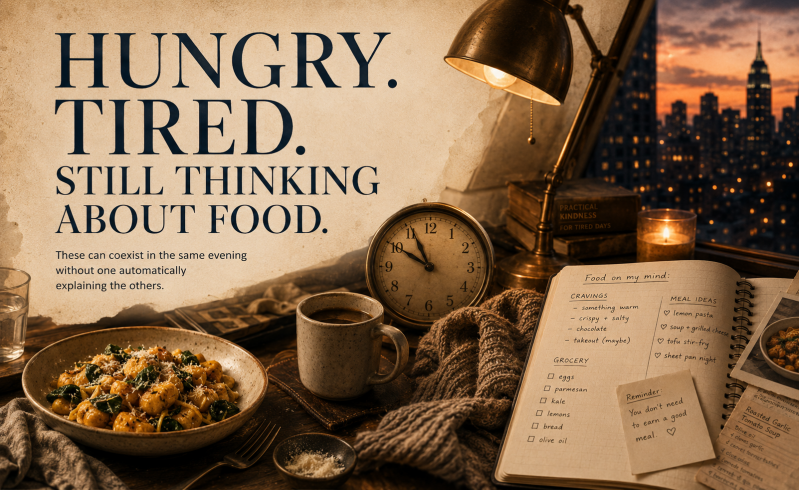
Hunger, Cravings, and Tiredness Can Show Up Together
One common question is whether evening hunger is “real hunger” or simply tiredness.
That question may be too narrow.
You can be tired and hungry.
You can be hungry and want one particular food.
You can be physically satisfied from dinner and still find something appealing.
And you can be mentally exhausted without that exhaustion explaining everything you want to eat.
Trying to force every experience into a single category can make an ordinary evening feel like something that needs to be solved before you are allowed to respond to it.
Sometimes the more useful question is simply: what is happening here tonight?
Look Back Before You Look at the Evening
Imagine two people eating cereal at 9 p.m.
One had lunch at noon, missed the chance to eat during the afternoon, arrived home late, and chose cereal because it was quick.
The other ate dinner an hour earlier, was not particularly hungry, noticed the cereal on the counter, and suddenly wanted it.
The behavior looks identical.
The situation is not.
That is why looking only at what happened at night can hide useful information.
It may help to look backward:
When did you last eat?
Was the day more demanding than usual?
Did a planned meal or snack disappear because something else took priority?
Did dinner require more preparation than you had energy for?
Were you following a rule earlier in the day that left the evening harder to navigate?
None of these questions automatically explains the evening. They simply give it context.
Tired Can Make “Easy” More Important
Dinner is not only food.
It can involve deciding what to eat, checking what is available, considering other people, preparing ingredients, cooking, waiting, serving, and cleaning up.
At eleven in the morning, a recipe that takes 35 minutes may sound perfectly reasonable.
At 7:30 after a difficult day, those same 35 minutes can feel very different.
That does not automatically mean your standards collapsed or your willpower disappeared.
It may simply mean that the cost of the option changed because your circumstances changed.
An easier dinner is not automatically a worse dinner.
Sometimes making evenings easier starts by reducing the amount of work the evening is expected to carry.
The Willpower Story Can Hide the Useful Question
When evenings repeatedly feel difficult, “I need more discipline” is an appealing explanation because it is simple.
But it does not tell you much.
It does not tell you whether lunch was enough.
It does not tell you whether dinner consistently arrives after a long gap without food.
It does not tell you whether every available option requires preparation you no longer want to do.
It does not tell you whether a restrictive rule earlier in the day is creating another negotiation later.
And it does not tell you whether tonight is simply an unusual evening.
Calling all of that a willpower problem can make the problem feel personal while leaving the practical conditions untouched.
A more useful question may be:
What is making this particular evening harder than it needs to be?
Try Looking for the Pattern, Not the Verdict
If evening hunger or cravings keep catching your attention, you do not need to conduct a complicated analysis every night.
For a few evenings, simply notice what came before.
You might look at:
when you last had an opportunity to eat;
whether you arrived at dinner already very hungry;
how mentally demanding the day felt;
whether the food available required more effort than you wanted to give;
whether the same pattern happens every evening or only under particular conditions.
The purpose is not to prove why you ate something.
It is to see whether the evening has a pattern.
A pattern gives you something concrete to work with.
A verdict about your character does not.
A Note About Persistent or Distressing Night Eating
Occasional evening hunger, cravings, or eating are not the same thing as a clinical eating disorder.
If nighttime eating is persistent, causes significant distress, involves recurrent loss of control, compensatory behaviors, or regularly wakes you from sleep to eat, that is a different situation and is worth discussing with an appropriately qualified health professional.
Further Reading
Want to Explore the Evening More Closely?
Eating When You’re Mentally Exhausted looks at why hunger, cravings, tiredness, and food decisions can become harder to untangle at the end of a long day—and why the evening often makes more sense when you look at what happened before it.
Explore the book, see what’s inside, and learn about the full audiobook included with it.
Keep Exploring
If this way of looking at everyday patterns is useful to you, you can receive occasional notes from Lucy Rowen — research-informed, practical, and without hype or rigid rules.